
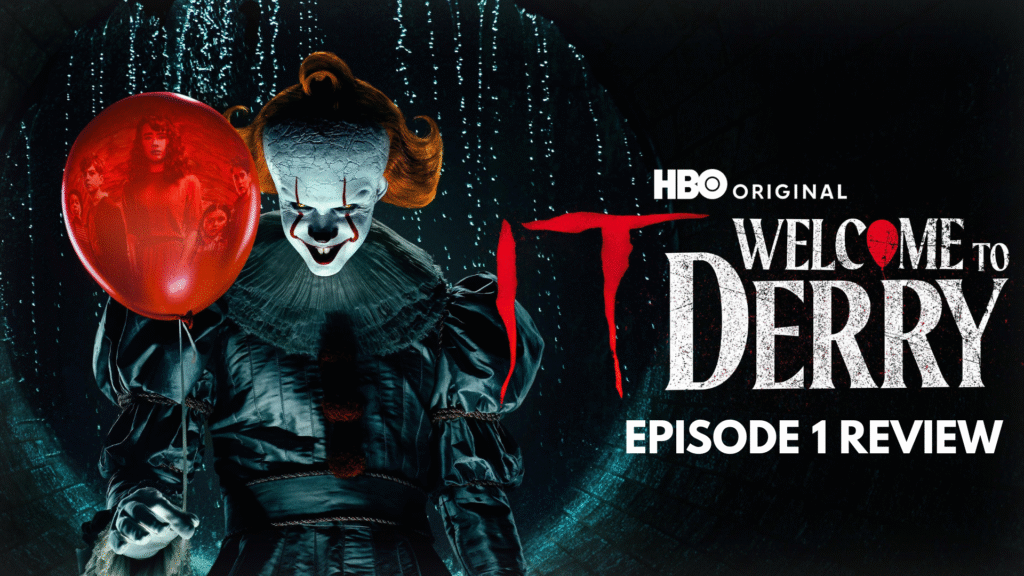
HBO’s IT: Welcome to Derry wastes no time establishing itself as one of the most visceral and disturbing entries in the horror television landscape. The series premiere, titled “The Pilot” and directed by Andy Muschietti, sets its stage in 1962 Derry, Maine—27 years before the events of the IT films—and delivers a masterclass in atmospheric dread, brutal violence, and socio-political horror that elevates the material beyond simple supernatural scares.
It: Welcome To Derry episode 1 - Story & Plot

The episode opens inside the Capitol Theater, where young Matty Clements (Miles Ekhardt) sneaks into a screening of The Music Man, specifically during Robert Preston’s performance of “Ya Got Trouble”. The song’s lyrics—warning that “children’s children gonna have trouble”—become a haunting prophecy and recurring motif throughout the episode. After being caught without a ticket, Matty attempts to escape Derry entirely, hitching a ride with what appears to be a wholesome 1960s family.
What follows is one of the most disturbing opening sequences in recent horror television. The family’s behavior turns increasingly sinister: the young girl compulsively spells ominous words like “maggots” and “strangulation,” munches on raw liver from a Tupperware container, and the parents exchange sexually inappropriate remarks. When Matty realizes they’re driving back into Derry rather than away from it, the mother goes into rapid labor and gives birth to a terrifying winged demon baby—a malformed creature with voids for eyes that launches itself at Matty.
The episode then jumps forward four months to April 1962, introducing two parallel storylines that will converge throughout the season. The first follows a new generation of young outcasts who begin investigating Matty’s disappearance: Lilly Bainbridge (Clara Stack), who was Matty’s closest friend and is still mourning her father’s gruesome death in a pickle factory accident; Teddy Uris (Mikkal Karim-Fidler), whose surname connects him to future Losers’ Club member Stanley Uris; and Phil Malkin (Jack Molloy Legault), whose rapid-fire theories echo Richie “Trashmouth” Tozier.
The second storyline introduces Major Leroy Hanlon (Jovan Adepo), grandfather of future Losers’ Club historian Mike Hanlon, a decorated Korean War veteran and Air Force pilot stationed at Derry Air Force Base. Adepo, known for his work in The Leftovers and Watchmen, brings gravitas to a character experiencing both supernatural and all-too-real horrors. Leroy faces immediate racial discrimination from fellow airmen, particularly Airman Second Class Masters who refuses to salute him. His storyline sets up what will likely be a deeper exploration of the Black Spot tragedy—a nightclub for Black servicemen that was burned down by Derry’s KKK, an event referenced in King’s novel and briefly mentioned in the 2017 film.
Once the investigation begins, the supernatural occurrences escalate rapidly. In a sequence echoing Beverly Marsh’s bathroom encounter from the films, Lilly hears Matty’s voice singing “Ya Got Trouble” from her bathtub drain. When she reaches toward the drain, bloodied fingers emerge—though no one believes her story. Teddy has his own terrifying encounter when his bedroom lampshade transforms into stitched faces of concentration camp victims, their mouths sewn shut in silent screams.
At a Shabbat dinner, Teddy’s father Rabbi Uris tells him that “We are Jews, Theodore. We know better than anyone the real horrors of this world”. The show’s use of Holocaust trauma as horror fodder has drawn criticism for being exploitative, particularly since the imagery appears without meaningful follow-up or exploration of what it means to Teddy and his heritage. The episode takes place only 17 years after the liberation of Buchenwald—close enough that many survivors would still be living with fresh trauma—making this creative choice particularly problematic for some viewers.
The episode’s climax represents a shocking departure from typical horror television structure. The children meet Ronnie Grogan (Amanda Christine), whose father Hank works at the Capitol Theater and was one of the last people to see Matty alive. As a Black family in Derry, the Grogans faced intense police scrutiny after Matty’s disappearance, with authorities trying to pin blame on Hank. Ronnie reveals she too has heard voices from the pipes—children screaming and singing the same song as Matty.
The group decides to screen The Music Man again, hoping to find answers. During the film, Matty appears on screen, cradling a baby and blaming his former friends for abandoning him at his birthday party. His face contorts into a sinister grin, and the demon baby from the opening sequence emerges through the screen into the theater. What follows is several minutes of brutal, unrelenting violence. The creature rips Teddy in half, his blood and guts spilling over the popcorn-strewn floor. It tears through Phil’s little sister Susie and the other children off-screen.
Only Lilly and Ronnie escape, with Lilly clutching what she realizes too late is Susie’s severed hand. In one devastating sequence, the show establishes that these aren’t simply “main characters” protected by plot armor—children can and will die horrifically, and no one is safe. Director Andy Muschietti explained this choice was essential: “It was important for audiences to know from the outset that Welcome to Derry wasn’t going to be a rehash of the IT movies”.
It: Welcome To Derry episode 1 - Theme

What elevates Welcome to Derry beyond standard horror fare is its unflinching integration of 1960s America’s real-world horrors with supernatural elements. The show doesn’t shy away from depicting institutionalized racism, segregation, police brutality, and white supremacy. Showrunner Brad Caleb Kane defended these choices: “You just show it how it is and how it was. This is unfortunately how it was in 1962 in America… And if painting a certain kind of reality is considered a woke agenda, that’s unfortunate”.
The series examines Cold War anxieties, with radio broadcasts about nuclear testing creating an atmosphere of pervasive dread. Characters reference the Cuban Missile Crisis, the Red Scare, and fears of nuclear fallout—all period-specific terrors that Pennywise can exploit. The show also addresses sexism and the silencing of women’s voices, with Charlotte Hanlon (Taylour Paige) noting how women in 1962 were dismissed as “hysterical” when they spoke up about injustice.
By setting the story during the civil rights movement, the show creates a powerful metaphor: Pennywise amplifies the hatred and fear already present in Derry’s population. The entity doesn’t create evil—it magnifies the existing cruelty, prejudice, and violence in the community. This makes the horror feel grounded and reflective rather than purely escapist.
It: Welcome To Derry episode 1 - Technical aspects
Visually, the series nails the aesthetic of 1960s small-town America while layering in uncanny dread. VFX supervisor Daryl Sawchuk and prosthetics head Sean Sansom revealed that the demon baby birth sequence was achieved primarily through practical effects. Using LED volume stages (similar to The Mandalorian) for interactive lighting, they kept the baby’s emergence “entirely practical” with real lighting, viscous fluids, and traditional puppeteering techniques.
“It was real lighting, viscous goo, and goop and all of that stuff. And it looks great, kind of an homage to old school horror and traditional techniques, with the benefits of some new technology,” Sawchuk explained. This blend of practical and digital effects creates visceral, tangible horror that feels more authentic than purely CGI-driven scares. The commitment to practical effects echoes John Carpenter’s The Thing—horror that ages well because it’s rooted in physical reality.
Cinematographer Andy Muschietti (who also directs) creates an atmosphere thick with dread through careful lighting and composition. The theater massacre sequence uses diegetic lighting that turns blood red, with the demon baby emerging from darkness in ways that maximize terror. Long shadows, cramped spaces, and claustrophobic framing make even mundane locations feel threatening.
It: Welcome To Derry episode 1 - Acting & direction

The young cast delivers nuanced, naturalistic performances that anchor the supernatural horror in emotional reality. Clara Stack’s Lilly Bainbridge conveys grief, trauma, and determination as a girl ostracized for her father’s death and her time in Juniper Hill psychiatric hospital. Mikkal Karim-Fidler’s Teddy brings intellectual curiosity and vulnerability to a character caught between childhood innocence and adult horrors.
Among the adult cast, Jovan Adepo and Chris Chalk (as Dick Hallorann from The Shining) deliver standout performances. Adepo discussed how easy it is to portray the fears of being Black in America: “It’s walking down the street and feeling that you’re making other people feel uncomfortable because you’re Black. That’s something that I’ve experienced before. So playing it on screen, I mean, that’s easy homework”.
Taylour Paige brings complexity to Charlotte Hanlon, a woman who was active in the civil rights movement in Louisiana and struggles with being silenced in Derry. “In that time it’s like just, and even just the considering of like how one dresses being kind of buttoned up…and like what that does to one’s body and the carefulness of the articulation of how one speaks,” Paige explained, capturing the multiple layers of oppression her character faces.
While Bill Skarsgård doesn’t appear as the iconic Pennywise clown in the premiere, his presence looms over every frame. The demon baby represents an earlier, more primitive manifestation of the entity—possibly Pennywise in a purer form closer to the Deadlights, the cosmic force of evil at the creature’s core.
The episode balances exposition with horror effectively, though it occasionally leans heavily on setup. Writer Jason Fuchs structures the premiere to introduce numerous characters and storylines while still delivering memorable scares. The cold open with Matty’s disappearance immediately establishes the stakes, while the four-month time jump allows the episode to explore how Derry has “moved on” even as the children refuse to forget.
The parallel adult and child narratives create thematic resonance—both groups face threats from entities that feed on fear, whether supernatural or societal. Major Hanlon’s racist attackers at the end of the episode mirror the creature attacking the children, suggesting Derry’s evil manifests in multiple forms.
It: Welcome To Derry episode 1 - Final verdict

IT: Welcome to Derry’s premiere episode is a bold, brutal, and disturbing introduction to a new chapter in Stephen King’s most successful horror franchise. The episode succeeds in distinguishing itself from the films through its willingness to kill sympathetic characters, integrate real-world horrors with supernatural threats, and commit to practical effects that create tangible terror.
The performances ground the horror in emotional reality, while the period setting allows the show to explore how fear—both supernatural and societal—shapes communities. The demon baby represents an inspired creative choice that taps into era-specific anxieties while introducing a fresh incarnation of Pennywise’s evil.
While the episode occasionally struggles to balance its ambitious scope, and certain creative choices regarding Holocaust imagery deserve criticism, the premiere ultimately delivers what horror fans crave: genuine scares, high stakes, and the unsettling feeling that something deeply wrong lurks beneath the surface of everyday life. As Matty’s pacifier disappears into the sewer and the iconic IT logo appears, viewers know they’re in for a terrifying journey through Derry’s darkest cycle.
Welcome to Derry is rich with Easter eggs and connections to King’s broader mythology. The Standpipe water tower, where the kids meet, was the site of Stan Uris’s encounter with drowned children in the novel. Lilly’s father’s death in a cannery, where he was pulled into machinery and packaged into pickle jars, directly references King’s gruesome short story “The Mangler”. Juniper Hill psychiatric hospital, where Lilly was institutionalized, appears throughout King’s Maine novels as a site of barbaric treatments.
For those who can handle visceral violence, psychological horror, and unflinching depictions of both supernatural and human evil, Welcome to Derry offers one of the most compelling horror premieres in recent television history. The show makes good on its promise: in Derry, trouble has indeed arrived—and it’s only just beginning.