
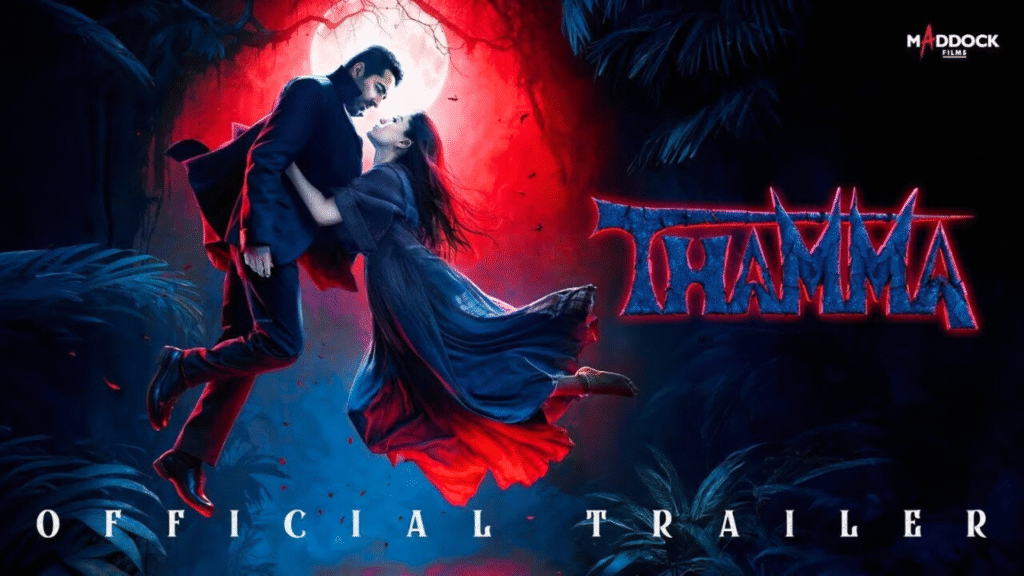
Ayushmann Khurrana and Rashmika Mandanna’s supernatural romance Thamma arrives as the fifth installment in Dinesh Vijan’s ever-expanding Maddock Horror Comedy Universe, releasing during the festive Diwali season on October 21, 2025. Directed by Aditya Sarpotdar, who previously helmed the comparatively entertaining Munjya, this vampire love story promises a fresh mythological twist on Indian folklore while maintaining the franchise’s signature blend of horror, humor, and heart.
With a stellar ensemble cast including Nawazuddin Siddiqui and Paresh Rawal, and a reported budget that makes it one of Maddock’s most expensive productions yet, Thamma attempts to carve its own niche in Bollywood’s burgeoning cinematic universe culture. But does this betaal-centric narrative deliver the same magic as its predecessors, or does it fall victim to the law of diminishing returns? Let’s find out.
Thamma: Story and plot

Thamma opens with an ambitious prologue set in 323 BC, where Alexander the Great ventures into a dense forest inhabited by blood-sucking vampires called betaals. This historical framing device immediately establishes the film’s mythological scope and connects to Indian folklore rather than Western vampire lore. The narrative then jumps to contemporary times, introducing us to Alok Goyal (Ayushmann Khurrana), a meek television journalist from Delhi who projects bravado but lacks genuine courage.
During a jungle assignment to create viral reel content, Alok encounters a ferocious bear that nearly costs him his life. Enter Tadaka (Rashmika Mandanna), a mysterious vampire from the betaal clan who rescues him from certain death and instantly falls in love at first sniff. However, Alok’s troubles are far from over. Three burly vampires attempt to capture him and serve him to their imprisoned leader, Yakshasan (Nawazuddin Siddiqui), who has been chained for 75 years and thirsts desperately for human blood after being punished for violating a critical rule established during the 1947 Partition riots.
The story takes an intriguing turn when Tadaka takes Alok back to his Delhi home, where she must conceal her true nature from his suspicious father (Paresh Rawal). As Tadaka struggles to find sustenance while pretending to be a normal girl named Tarika, she discovers liquor as a blood substitute during a dinner outing. When a group of men harass them, Tadaka unleashes her betaal powers, leading to complications when a senior police officer—himself a member of the betaal sect—warns her about the consequences. To protect Alok, Tadaka decides to return to her realm, but fate has other plans as Alok himself undergoes a vampiric transformation, shouldering the entire burden of saving both worlds.
The film weaves together multiple mythological threads, including references to Rakt Beej and Goddess Durga, establishing that betaals descended from creatures who once drank Rakt Beej’s blood and ultimately trace their origin to the divine goddess. This cosmological framework adds depth to the supernatural world-building while connecting to upcoming films in the Maddock universe, particularly the announced Shakti Shalini.
Thamma: Acting & direction

The acting ensemble of Thamma remains its most consistent strength, with each performer bringing conviction to roles that could have easily descended into caricature.
Ayushmann Khurrana delivers what many consider one of his most intense and layered performances. Playing an Indian betaal—a character with no clear reference point in Hindi cinema—Khurrana navigates the dual shades of his role with remarkable conviction. His transformation from a gormless, pretentious journalist to a blood-craving supernatural being showcases impressive range. The actor particularly shines in the second half, where his character’s metamorphosis demands both physical and emotional commitment. Khurrana’s natural comic timing helps salvage scenes where the humor falls flat, and his ability to convey vulnerability makes Alok’s predicament genuinely engaging. The film marks his career-best opening with ₹25.11 crore on day one, vindicating his reputation as “Mr. ROI” for producers.
Rashmika Mandanna emerges as the film’s revelation and, for many critics, its soul. Her portrayal of Tadaka represents easily her best role in Bollywood so far, with the character being superbly written to showcase both vulnerability and ferocity. Playing a vampire walks a fine line—one small misstep can make things look ridiculous—but Rashmika handles it brilliantly. She carries mystery and emotion effortlessly through her expressive eyes, which do as much talking as her prosthetic Dracula teeth. Critics consistently praise how she mesmerizes viewers with her natural and heartfelt performance. Fans flooded social media calling her the “most iconic vampire ever,” with many declaring she “ate the teaser” with unmatched energy.
Nawazuddin Siddiqui brings exceptional flash and flair to the titular role of Yakshasan. His brilliantly modulated performance borders on the excessive at times, but this aligns with the character’s villainous grandeur. However, Siddiqui represents both a strength and a major disappointment—while his presence adds gravitas, the character itself proves underwhelming. Yakshasan is neither menacing nor mysterious, coming across as a loud caricature rather than the terrifying antagonist the film needs. He stands as perhaps the weakest villain in the entire Maddock Horror Comedy Universe, wasted by a script that doesn’t give him sufficient menace or depth. The climax should have showcased his power more effectively, but instead reduces him to theatrical shouting.
Paresh Rawal excels in his supporting role, stealing scenes with impeccable comic timing and surprising emotional depth. His delivery of meta-jokes—including blessing Ayushmann’s character with a cheeky “Ayushmann Bhava”—provides some of the film’s genuine laugh-out-loud moments. The veteran actor adds warmth to the family sequences and grounds the supernatural proceedings with his everyman reactions.
The film also benefits from strategic cameo appearances that have become a hallmark of the MHCU. Varun Dhawan reprises his role as Bhediya, appearing in a muscular, more powerful version than seen in the original film. His scene serves as one of the film’s highlights, establishing a thrilling connection to the larger universe and setting up the much-anticipated confrontation between Thamma and Bhediya in future installments. Abhishek Banerjee returns as Jana (also known as JD or Janardhan), maintaining continuity from Stree and Bhediya.
Director Aditya Sarpotdar demonstrates a flair for stylish world-building and creates a visually arresting supernatural universe. After delivering the comparatively perky Munjya, Sarpotdar attempts to expand his canvas with Thamma, venturing into a completely fictional vampire subject for the first time. His direction shows confidence in handling the romantic, comedic, and supernatural elements, with smooth transitions between love, fear, and fantasy. However, the result proves uneven, with the law of diminishing returns clearly setting in.
Thamma: Technical aspects
The screenplay—written by Niren Bhatt, Suresh Mathew, and Arun Falara—represents the film’s fundamental failing. Despite three writers collaborating, they could not create a consistently gripping or thrilling story. The central concept of blending Indian folklore with contemporary storytelling intrigues, but the execution falters significantly. The narrative becomes tangled at several moments, with scenes feeling overly long and repetitive. What should be a taut supernatural thriller stretches to an unwieldy 2 hours and 30 minutes, testing audience patience especially in the first half.
The pacing issues plague the film from the outset. The opening sequences move at a glacial pace, with the story taking considerable time to pick up momentum. The first half has been variously described as “boring,” “tedious,” “slow,” and requiring “considerable patience” from viewers. Only after the interval does the film find its footing, with the second half delivering a much better payoff and maintaining stronger engagement. However, by then, the damage to the viewing experience has already been done.
The dialogues, despite being crafted by three writers, repeatedly fail to land as funny or impactful. The attempts at humor often feel forced, with vampire-related jokes entertaining initially but becoming tiresome and repetitive in the second half. The risqué humor and meta-movie references that worked brilliantly in Stree and Bhediya don’t generate the same laughs here.
Where Thamma truly excels is in its technical execution, presenting a visually rich experience that demonstrates Maddock Films’ commitment to production values. Saurabh Goswami’s cinematography stands as one of the film’s highlights, beautifully capturing eerie yet enchanting forest landscapes. From foggy hills and ancient ruins to dreamy night sequences, the visual palette creates an atmospheric supernatural world.
The VFX work receives generally positive assessments, with shots looking refined rather than overdone, giving the film a sleek, international vibe. The visual effects team avoids the trap of excessive CGI that plagued Munjya, maintaining a more grounded aesthetic even when depicting supernatural transformations and powers. However, some reviewers find the effects merely serviceable rather than groundbreaking.
Hemanti Sarkar’s editing shows sharpness in individual sequences, but the overall pacing problems suggest editorial choices that favored spectacle over tightness. Trimming at least one or two songs would have significantly improved the flow. The 150-minute runtime feels bloated, with several sequences that could have been condensed without losing narrative coherence.
The production design by Subrata Chakraborty creates a lavish visual world. Sets resembling Delhi houses, streets, and graveyards were constructed at Film City, Mumbai, while the vampire realm’s underground kingdom features grand, detailed design work. The film boasts impressive art direction, with a betaal watering hole sequence showcasing shelves of blood aged over centuries—a clever detail that adds texture to the world-building.
Thamma: Music and commercial aspects

The musical landscape of Thamma, composed by Sachin-Jigar with lyrics by Amitabh Bhattacharya, presents a mixed bag. The album features several tracks: “Tum Mere Na Huye” (sung by Madhubanti Bagchi and Sachin-Jigar), “Rahein Na Rahein Hum” (sung by Soumyadeep Sarkar and Sachin-Jigar), “Poison Baby” (sung by Jasmine Sandlas, Sachin-Jigar, and Divya Kumar), and “Dilbar Ki Aankhon Ka” featuring Nora Fatehi (sung by Rashmeet Kaur and Jigar Saraiya).
The songs themselves are catchy and have become hits on streaming platforms. “Poison Baby” and “Dilbar Ki Aankhon Ka” work as energetic item numbers, with both Malaika Arora and Nora Fatehi setting the screen ablaze with their performances. The background score by Sachin-Jigar receives more favorable assessment, heightening tension in key moments with haunting, melodic, and memorable compositions. The score effectively supports both the romantic and supernatural elements, though some critics find it occasionally overpowering.
Thamma embraces its position within the Maddock Horror Comedy Universe more enthusiastically than any previous installment except Stree 2. The film directly connects to both Stree and Bhediya, with the ending containing several hints that excite audiences for upcoming sequels.
The universe-building began with Stree in 2018 as a standalone film, expanded with Bhediya in 2022 (which featured characters from Stree), continued with Munjya in 2024 (showcasing characters from both previous films), and reached a peak with Stree 2 in 2024. Thamma now positions itself as a central node in this interconnected web, with Stree and Bhediya serving as the primary links connecting all films.
The post-credit sequences and climactic confrontations set up multiple future storylines. The film builds toward an epic Thamma vs. Bhediya face-off, likely to feature prominently in Bhediya 2. The introduction of the Betaal mythology—creatures descended from those who drank Rakt Beej’s blood, with origins tracing back to Goddess Durga—creates thematic connections to the announced Shakti Shalini, another form of Goddess Durga.
Most intriguingly, the ending reveals Sarkata (the villain from Stree 2, played by Akshay Kumar) releasing Yakshasan from captivity, forming a sinister alliance. This development indicates the rise of a dark army threatening the entire MHCU and sets up a potential mega-crossover event where Thamma, Bhediya, Stree, Shakti Shalini, and possibly Munjya must unite against Sarkata’s forces.
Thamma opened to impressive box office numbers, demonstrating the drawing power of the Maddock brand, the Diwali holiday advantage, and Ayushmann Khurrana’s growing commercial appeal. The film earned ₹25.11 crore net (₹29.89 crore gross) in India on its opening day, marking Ayushmann Khurrana’s career-best opening and surpassing his previous records from Dream Girl 2 (₹10.69 crore) and Bala (₹10.15 crore).
Adding overseas collections of approximately ₹1.32 crore (just under $250K), the worldwide gross on day one reached an impressive ₹31.21 crore. This represented the third-highest opener for Maddock Films overall and second-highest in the MHCU, right after Stree 2.
The occupancy rates tell an interesting story about the film’s performance trajectory. Morning shows started with relatively low 15.76% occupancy in Hindi markets, reflecting a cautious audience approach. However, afternoon shows jumped to 39.81%, evening shows reached 42.91%, and night shows maintained 39.50%, indicating positive word-of-mouth and the benefit of Diwali holiday viewing patterns. In premium locations, occupancy soared to 53.63%.
Thamma: Final verdict
Thamma represents both the promise and the peril of Bollywood’s expanding cinematic universe culture. On one hand, it demonstrates Maddock Films’ commitment to ambitious world-building, technical excellence, and fresh mythological storytelling rooted in Indian folklore rather than Western templates. The film succeeds in expanding the MHCU’s mythology through its betaal lore, sets up multiple exciting future crossovers, and features genuinely strong performances from its lead cast—particularly Rashmika Mandanna’s career-best turn as Tadaka.
The visual grandeur cannot be denied. Saurabh Goswami’s cinematography creates an atmospheric supernatural realm, the production design showcases lavish attention to detail, and the refined VFX work maintains a sleek aesthetic. The climactic confrontation delivers the spectacle audiences expect from a big-budget Diwali release, and the universe connections genuinely excite fans invested in the MHCU’s future.
However, Thamma ultimately proves that strong execution can only partially compensate for weak foundational elements. The screenplay’s fundamental problems—sluggish first-half pacing, repetitive humor, tangled narrative threads, and thematic emptiness—undermine the technical achievements and performances. At 150 minutes, the film tests patience with unnecessary songs that break momentum and scenes that overstay their welcome. Most critically, unlike Stree, Bhediya, and Munjya, which balanced entertainment with social commentary, Thamma offers spectacle without substance, thrills without genuine scares, and romance without emotional depth.
The film serves its purpose as a universe-building installment and provides adequate Diwali entertainment for franchise devotees and fans of the lead actors. The box office success validates Maddock’s brand strength and Ayushmann Khurrana’s commercial evolution. Yet compared to the sharp, witty, and socially relevant Stree or the environmentally conscious, technically superior Bhediya, Thamma feels like a step sideways rather than forward. It’s an enjoyable but uneven watch—a film of striking highs and evident lows that ultimately settles into adequacy rather than excellence.
For those invested in the Maddock Horror Comedy Universe, Thamma remains essential viewing to understand upcoming crossovers and appreciate the expanding mythological framework. Casual viewers seeking a complete, satisfying theatrical experience might find the investment of time and ticket price only partially rewarded. The film proves that building a cinematic universe requires more than cameos and references—it demands consistently strong storytelling that makes each installment compelling both as a standalone narrative and as part of a larger tapestry.
Thamma movie rating – 6/10 stars